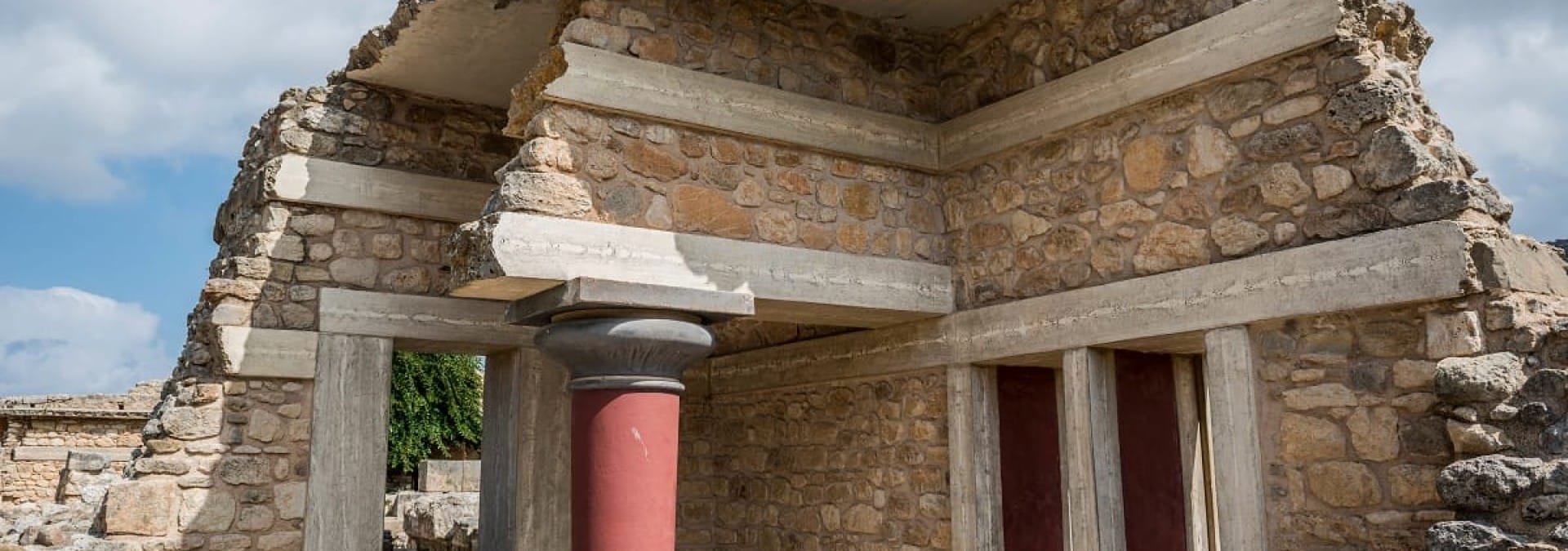
The Palace of Knossos: Thea Cradle of Minoan Civilization
Explore the Palace of Knossos, the heart of Minoan Civilization. Learn about King Minos, the Labyrinth, and the history of Arthur Evans' excavations.
The Minoan Palace of Knossos was the most significant city in Crete before the Roman era and the heart of the Minoan Civilization - Europe's first grand palace culture. Located just 5km south of Heraklion on Kephala Hill, it attracts over 1,000,000 visitors annually.
Myth and Legend
Knossos is inextricably linked to the legends of King Minos, the son of Zeus and Europa. It is the setting for the world-famous myths of Daedalus and Icarus, as well as the Labyrinth and the Minotaur. At its peak, the city was home to over 100,000 residents, and its symbols - the labrys (double axe) and the bull's horns - are still visible throughout the site.
Excavation and Controversy
The site was first explored in 1878 by the local enthusiast Minos Kalokairinos. However, it was the English archaeologist Arthur Evans who conducted systematic excavations from 1900 to 1930. Evans is famous (and criticized) for his extensive reconstructions using concrete. While controversial among archaeologists, these restorations provide a vivid image of the palace's original grandeur.
Historical Timeline
- Neolithic Period (7000-4000 BC): Earliest traces of habitation.
- 1900 BC: Construction of the first palace, destroyed by an earthquake in 1700 BC.
- 1700-1450 BC: Building of the magnificent "New Palace." Despite earthquake damage in 1600 BC, it was quickly restored; this is the structure seen today.
- 1450 BC: Massive destruction caused by an earthquake or tsunami following the Santorini volcanic eruption.
- 1350 BC: The palace falls into ruins following the arrival of the Mycenaeans.
The city of Knossos continued to be a powerful rival to cities like Gortyn and Lyttos until 500 AD, eventually losing its prominence to Gortyn during the Roman era.