Lasithi Plateau: The Sacred Birthplace of Zeus
Explore the Lasithi Plateau, the mythical birthplace of Zeus, featuring thousands of windmills, historic monasteries, and the rich traditions of Crete.
The idyllic Lasithi Plateau, mythical birthplace of the god Zeus, is located 25km south of Malia and 70km southeast of Heraklion. Nestled within the rugged peaks of the Dikti mountains and surrounded by smaller plateaus, this fertile plain sits at an altitude of 800m to 850m, making it one of the highest inhabited island regions in the Mediterranean. Tzermiado serves as the administrative capital, while other significant villages include Agios Georgios and Psychro, famous for its springs. During winter, the plateau is often blanketed in snow, attracting thousands of visitors, while snow sometimes lingers on the peaks until early summer. The 18 picturesque villages are built at the foot of the mountains to keep the plain free for cultivation, all connected by a 23km circular road—an ideal route for cycling and site-seeing. Since 1980, this road has also hosted the annual Diktaian Road Race every summer.
Top Sights and Landmarks
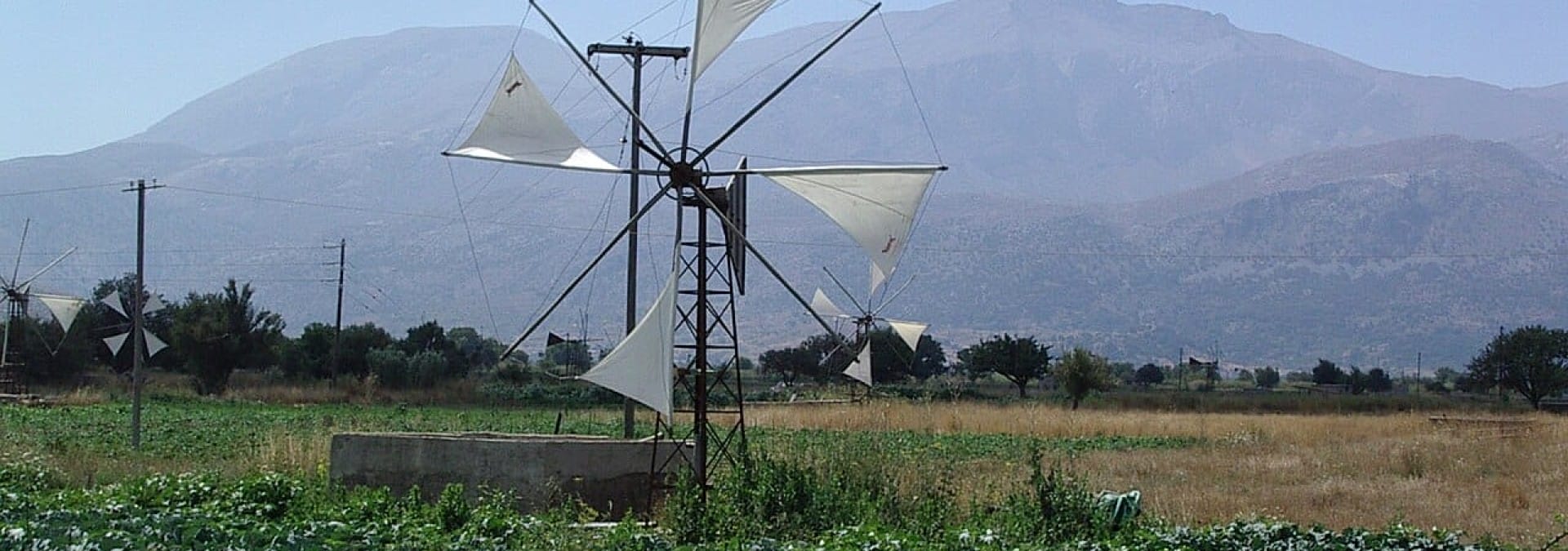
The plateau is world-renowned for its white-sailed windmills, a symbol of local identity. Constructed mainly in the late 19th century for irrigation, there were once over 12,000 of these metal structures. Today, while most have been replaced by modern pumps, efforts are being made to restore them for aesthetic and cultural reasons. At the entrance of the plateau, at Seli Ampelou, you will find Greece's largest complex of stone flour mills, consisting of 27 historic structures used for grinding grain.
Another highlight is the "linies" (from the Latin linea), a massive drainage system built by the Venetians to reclaim what was then a marshland. This transformed the area into Crete's most vital granary, which still produces high-quality vegetables. Nature lovers can explore the Havgas Gorge, which carries water from the higher Katharo Plateau and forms part of the E4 European trail. The Megallos Potamos (Great River) flows through the plain into the Honos (sinkhole), eventually feeding the Aposelemis Dam.
Religious sites include the historic Kroustalenia Monastery, a hub for past revolutions, and the restored Vidianis Monastery, which houses a small Natural History Museum. In Agios Georgios, visitors can explore the Eleftherios Venizelos Museum and the Folklore Museum. For hikers, the E4 trail leads to the Late Minoan settlement of "Karfi" (Ariadne’s Seat), offering breathtaking views of the northern coast. However, the most famous site is the Psychro Cave (Diktaion Antron), where, according to mythology, Rhea gave birth to Zeus.
A Rich Historical Tapestry
Farmed since Minoan times, Lasithi is considered the last stronghold of the Minoan civilization against the Dorians. During the Venetian era, habitation was initially banned as the remote plateau served as a rebel sanctuary. Later, the Venetians resettled the area and implemented the drainage projects, dividing the land into 193 plots called lassiti (or lasciti), likely giving the region its modern name.
The Great Battle of Lasithi (1867)
The plateau was a focal point of resistance during Ottoman rule. The most significant event was the "Gigantomachia" (The Battle of Giants) of Lasithi in May 1867. Following the Holocaust of Arkadi, Omer Pasha invaded with 25,000 troops. Despite fierce resistance, the Ottomans entered through "Tsouli Mnima," devastating the villages for ten days. However, the rebels regrouped at Limnakaro and defeated the exhausted Ottoman forces near Marmaketo. The scale of the Turkish atrocities in Lasithi pressured the Great Powers to demand Cretan autonomy. In honor of this struggle, the prefecture was officially renamed Lasithi.