Arkadi Monastery: The Sacred Symbol of Cretan Freedom
Explore the historic Arkadi Monastery in Rethymno, Crete. Discover the heroic Holocaust of 1866, its unique Renaissance architecture, and its legacy as a global symbol of freedom.
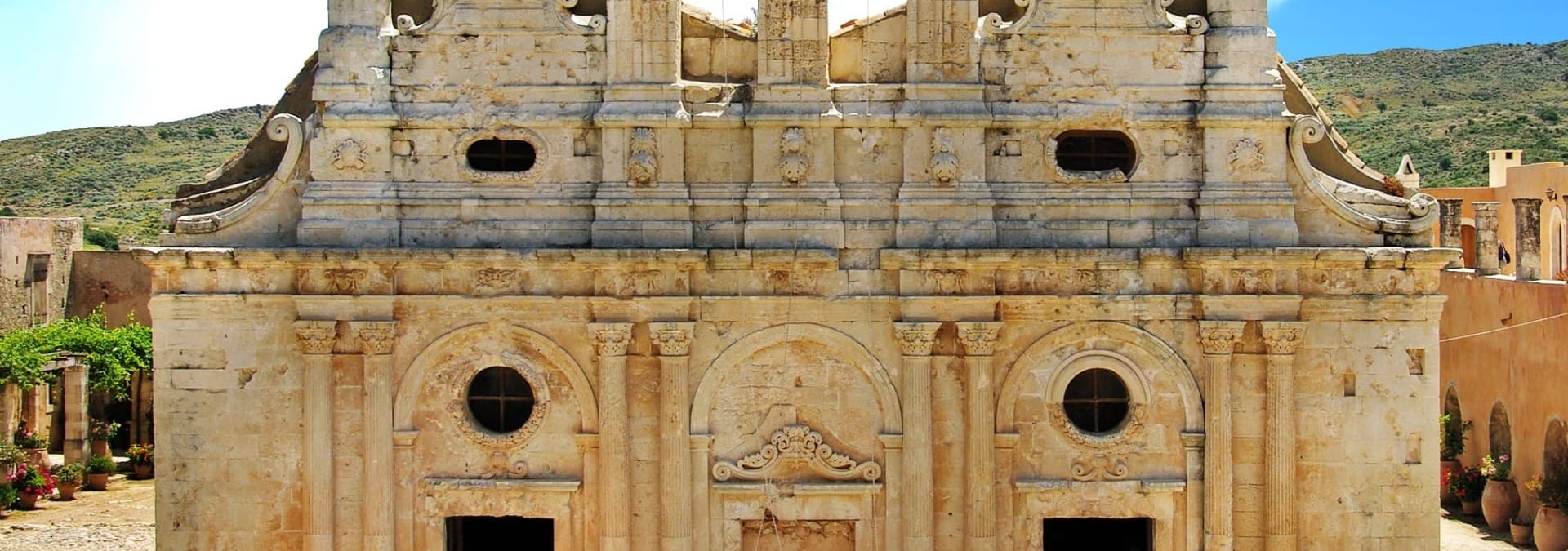
Arkadi Monastery is located on a fertile plateau 23km east of Rethymno at an altitude of 500m. Known during Ottoman times as "Tsanli Manastir" (the monastery with the bell), it held the unique privilege of ringing its bell when all others were forbidden. The complex is a fortified quadrangle, its outer walls forming a defensive perimeter that protects the Abbot's quarters, the Refectory, and the storerooms. At its heart lies the Katholikon, a 16th-century church featuring a world-renowned facade blending Renaissance and Baroque styles.
The Holocaust of 1866
The Great Cretan Revolution of 1866 was a turning point for Crete. Arkadi became the revolutionary hub, with Abbot Gabriel Marinakis serving as a leader. When Ismail Pasha demanded the surrender of the Revolutionary Committee, the Abbot chose resistance.
- The Siege: On November 8, 1866, a massive force of 15,000 Ottoman troops led by Suleiman Bey besieged the monastery. Inside were 964 people - mostly women and children, with only 325 armed men. Despite a heroic defense under the banner of the Transfiguration, the heavy Turkish artillery shattered the western gate on the morning of November 9.
- The Sacrifice: As the enemy swarmed the courtyard, fierce hand-to-hand combat ensued. In the powder magazine, Konstantinos Giamboudakis waited for the Ottoman soldiers to gather at the entrance. He then fired his pistol into the gunpowder barrels. The massive explosion martyred the defenders but killed hundreds of enemy troops, creating an event that echoed across the globe.
- The Legacy: The Holocaust of Arkadi resulted in 864 Cretan deaths and approximately 1,500 Turkish casualties. This ultimate sacrifice shocked Europe, forcing the Great Powers to address the "Cretan Question," which eventually led to the island's liberation in 1898. UNESCO has since designated Arkadi a European Monument of Freedom.
Historical Timeline
- 12th Century: Emperor Arcadius reportedly rebuilds the monastery.
- 1587: Monks Klemes and Vissarion Hortatzis renovate the monastery and build the current church.
- 1645-1658: The monastery is looted but retains the privilege of the bell.
- 1822: Captured by Getim Ali and later reclaimed by Amari rebels.
- Nov 7-9, 1866: The historic Holocaust of Arkadi takes place.
- 1870: The ruined monastery is restored.
- 1933: The museum is established to house sacred relics and the revolutionary banner.