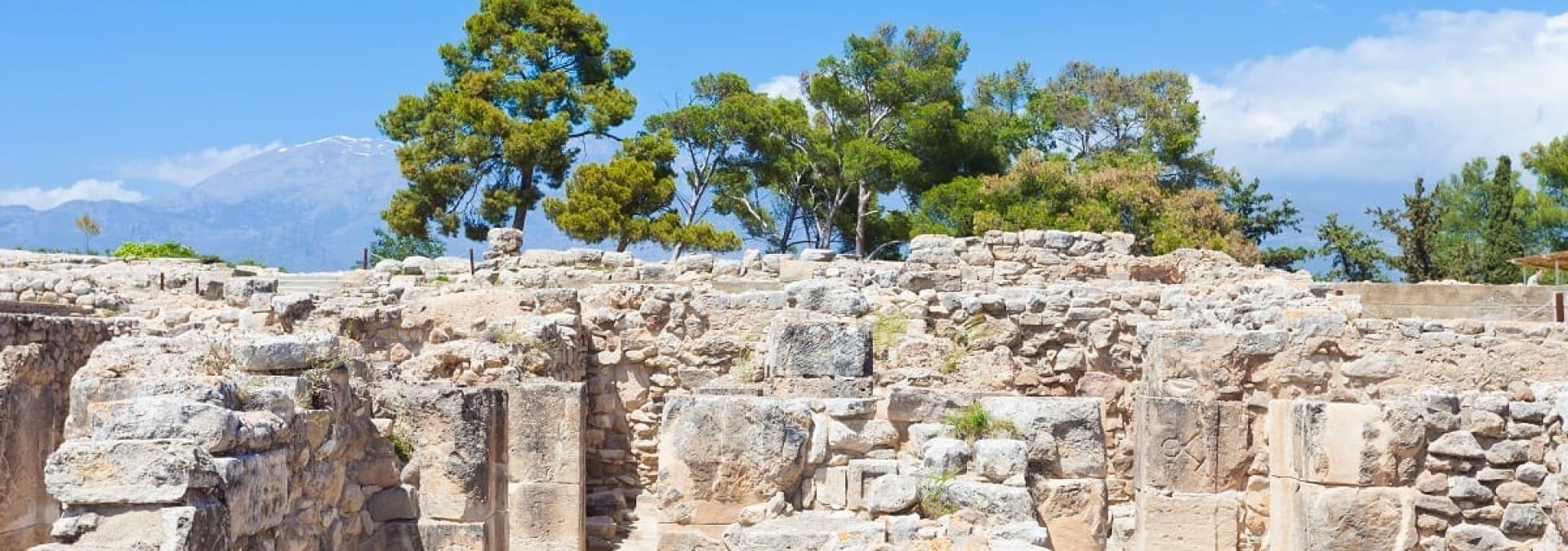
Phaistos: The Radiant Center of the Minoan South
Visit ancient Phaistos, Crete's second most important Minoan palace, and discover the history of Rhadamanthus and the legendary Phaistos Disc.
Phaistos, built upon a low hill overlooking the fertile Lower Messara valley, is one of Crete's most significant archaeological sites. Located south of the Geropotamos River (the ancient Lethaios), which served as the city's water source, it is surrounded by the majestic peaks of Mt. Psiloritis, the Asterousia Mountains, and the Lasithi Mountains. Its strategic location and mild climate fostered the development of one of the most powerful cities of the Minoan civilization.
Mythology and Historical Evolution
According to mythology, Phaistos was ruled by the dynasty of Rhadamanthus, son of Zeus and brother of Minos. The city is mentioned by Homer for its participation in the Trojan War and is characterized as "well-inhabited," while ancient writers like Strabo and Pausanias attest to its wealth.
Inhabitation dates back to the Neolithic period, as evidenced by foundations and artifacts discovered beneath the palace. However, its peak began with the Bronze Age. The First Palace was constructed around 1900 BC, covering an area of 18,000 square meters. Following its destruction by a massive earthquake circa 1700 BC, a New Palace was built - even more imposing - the ruins of which constitute the majority of what visitors see today.
A Powerful City-State and Its Harbors
Phaistos was not merely a palatial center but a powerful, independent, and populous city-state. It controlled the rich Messara plain and commanded two significant harbors, Matala and Kommos. During its zenith, its dominion stretched from Cape Lithino to Cape Melissa, and the city even minted its own currency.
Despite the destruction of the palaces in the 15th century BC, Phaistos remained inhabited through the Mycenaean and Geometric periods. The city flourished again during the Hellenistic era; however, its decline came in the mid-2nd century BC (approx. 160 BC) when it was conquered and enslaved by the neighboring city of Gortyn.
Archaeological Significance and Excavations
Archaeologically, Phaistos is considered the second most important Minoan city after Knossos. The site was first identified by the British captain H. Spratt. Systematic excavations began in 1884 by F. Halbherr and were continued by the Italian School of Archaeology throughout the 20th century. These efforts brought to light extraordinary treasures, most notably the world-famous Phaistos Disc.