Heraklion: A Journey Through Time
Discover Heraklion, the vibrant capital of Crete. Explore world-class landmarks like the Palace of Knossos, the Archaeological Museum, and Venetian fortresses. Experience the perfect blend of ancient history and modern Cretan life.
From the Minoan Dawn to the Modern Age
Heraklion is much more than the capital of Crete; it is a city that has served as a crossroads for empires, pirates, and rebels. Its story begins at the very dawn of European civilization and continues through centuries of epic sieges and cultural rebirth.
The Minoan and Ancient Roots
In prehistoric times, Heraklion served as the main gateway to the sea for the Palace of Knossos. Archaeological excavations at the areas of Katsabas and Poros have revealed Minoan harbor installations, proving that the city's maritime importance is over 3,500 years old.
The name Heraklion is derived from the myth of the Idaean Heracles (not to be confused with the hero of the Twelve Labors). According to legend, he was one of the guardians of the infant Zeus and organized the first-ever footrace in Olympia. This myth highlights Crete as the birthplace of athletics, a passion reflected in the Minoan frescoes of bull-leaping and wrestling.
The Arab Khandaq and the Byzantine Quest
During the first Byzantine period, the town was a small settlement known simply as Kastro (Castle). However, in 824 AD, Saracen Arabs expelled from Spain seized the island. They chose Heraklion as their capital, fortifying it with a massive wall of unbaked bricks and a deep moat.
The city was named Rabdh el Khandaq (Castle of the Moat), which later became Handakas in Greek and Candia in Latin. For over a century, it was a feared stronghold for pirates. In 961 AD, the Byzantine general (and later Emperor) Nikephoros Phokas liberated the city after a legendary siege, restoring it as the "Great Castle" of the Mediterranean.
The Venetian "Candia": The Venice of the East
In 1211, the Venetians took control of Crete, and Heraklion - now called Candia - became the capital of the "Kingdom of Candia." For nearly five centuries, it was the most important political and commercial hub in the Eastern Mediterranean.
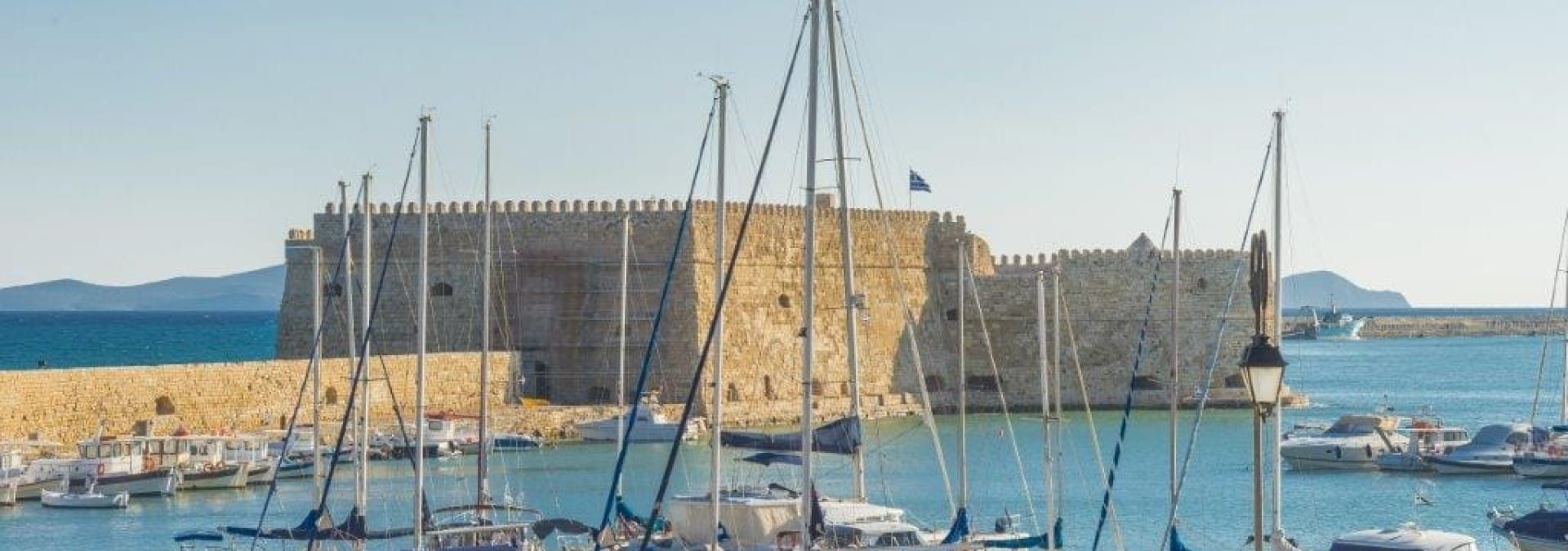
This was the era of the Cretan Renaissance. As the bond between the locals and Venetians grew, arts and letters flourished. Iconic monuments like the Loggia, the Morosini Fountain (Lions Square), and the Koules Fortress were built. It was during this time that the world-renowned "Cretan School" of iconography emerged, influencing artists like El Greco, while literature peaked with works like the epic poem Erotokritos.
The Great Siege and Ottoman Rule
The city’s strength was put to the ultimate test in 1647 when the Ottoman Turks began the Siege of Candia. Lasting 22 years, it remains the longest siege in world history. Despite the incredible resilience of the fortified walls, the city finally fell in 1669 following a betrayal.
Under Ottoman rule, the city entered a period of relative decline. Churches were converted into mosques, and the city took on a typical Balkan character with narrow alleys and minarets. It wasn't until the 1800s that the city officially reclaimed its ancient name, Heraklion, as the spirit of Greek independence began to grow.
The 20th Century: Union and Resistance
Following the union of Crete with Greece in 1913, Heraklion transformed into a modern metropolis. The 1922 population exchange brought thousands of Greek refugees from Asia Minor, who breathed new life into the city and created new neighborhoods like Nea Alikarnassos.
During World War II, Heraklion faced its darkest days. During the Battle of Crete in May 1941, German bombers devastated one-third of the city. The locals, however, put up a fierce resistance. One of the most famous acts of defiance was the 1942 sabotage of the German airfield. In retaliation, the Nazis executed 62 prominent citizens, a sacrifice honored today by the name of "62 Martyrs Avenue."
The city was finally liberated on October 11, 1944, standing today as a vibrant city that proudly wears the scars and glories of its 3,000-year history.