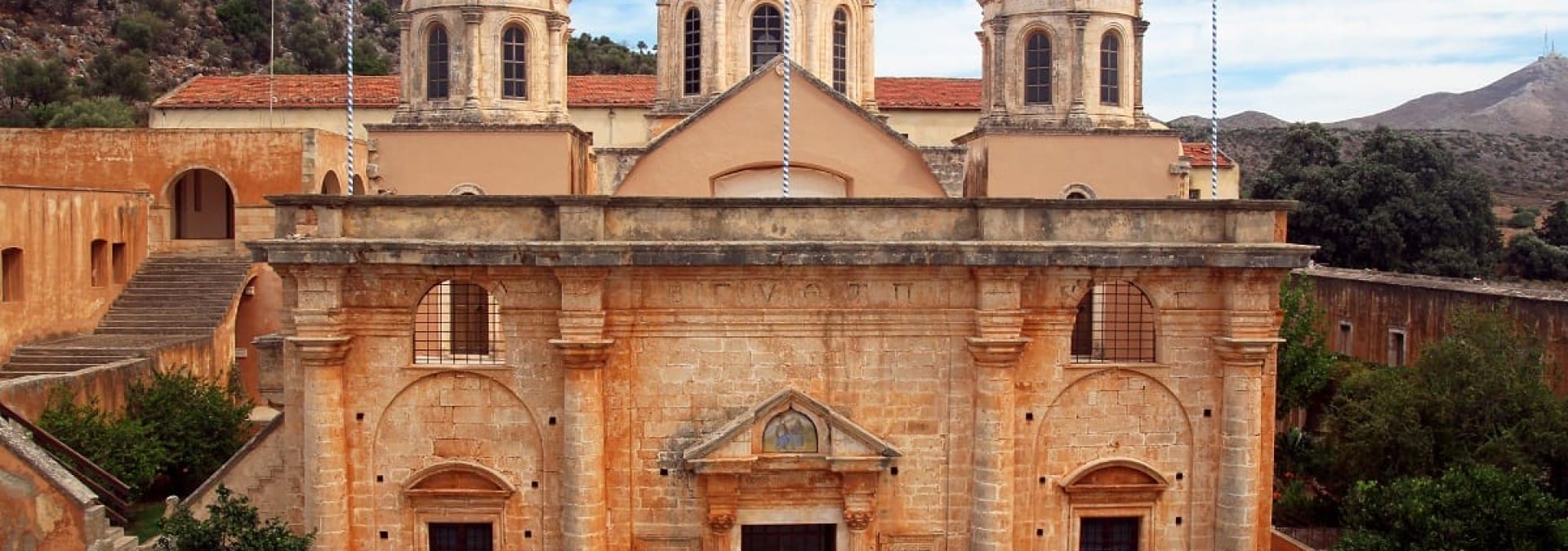
Agia Triada Tsagarolon Monastery
Located just 15 km from the city of Chania, Agia Triada (Holy Trinity) is one of the most affluent and visually stunning monasteries in Crete.
It is not merely a place of worship but an architectural masterpiece that beautifully blends Orthodox tradition with Italian Renaissance aesthetics.
Location: Akrotiri, Chania (at the foothills of the Stavros mountains)
A Vision of Faith and Art
The monastery was founded in the 17th century by two brothers from the prominent Venetian-Cretan Tsagarolo family. Jeremiah, a highly educated scholar with both Greek and Italian schooling, designed the complex himself. He drew inspiration from the architectural treatises of Sebastiano Serlio of Verona. After Jeremiah’s death in 1636, his brother Laurentios continued the ambitious project, which was eventually completed in the 19th century after surviving the Ottoman conquest and the devastating fire of 1821.
Architecture and the Great Church
The approach to the monastery is breathtaking, featuring a long road lined with towering cypress trees leading to a grand stone staircase.
- The Complex: Built as a fortified quadrangle with a central paved courtyard, it includes olive presses, wine cellars, a library, and monk cells.
- The Katholikon: The central church is a tri-conch design with impressive domes. Its facade features strict geometric symmetry and Renaissance elements.
- The Museum: The monastery houses a small but precious museum containing 12th-century manuscripts, 16th-century icons by the famous painter Emmanuel Skordylis, and rare ecclesiastical vestments.
A Living Tradition of Excellence
Today, Agia Triada remains a Stavropegic monastery (governed directly by the Ecumenical Patriarchate). It is a vibrant community renowned for its production of premium organic products, which are exported worldwide:
- Award-winning Organic Olive Oil
- Exceptional Wines and Balsamic Vinegar
- Pure Honey and Olive Oil Soaps
Historical Timeline
- 1611: Jeremiah Tsagarolo begins rebuilding the older "Mourtari" monastery into a grand new complex.
- 1645: Construction is interrupted by the Ottoman invasion of Western Crete.
- 1821: During the Greek Revolution, the monastery is looted and set on fire by Ottoman forces.
- 1830: Permission is granted to complete the church; the monastery enters a period of reconstruction and expansion.
- 1892: An ecclesiastical school is established in the eastern wing.
- 1896-97: The monastery serves as a hospital and headquarters during the final Cretan Revolution.
- 1941-44: Occupied by German forces during WWII, after initially serving as a supply depot for the Greek Navy.